Using the UIC Databases
The portion of the Office of Oil and Gas online databases that was saved in 2016 is useful in many ways. The tables give an idea of the breadth and scope of the Office's activities pertaining to Underground Injection Control. The tables also give an idea of changing patterns of activities, such as frequency of inspections conducted. The inspections table gives an idea of the range of issues and violations that inspectors have found at UIC wells over the years.
Most of the activities covered in the tables are related to state law and regulation. There are also specific permit requirements, such as having a pressure gauge to measure injection pressure and another gauge to measure annular pressure.
UIC permits are for 5 years and have to be renewed in a timely manner (by regulation, permit renewals need to be submitted 6 months in advance of permit expiration). Similarly, Mechanical Integrity Tests (MITs) have to be conducted on wells within 5 year cycles. A well with a MIT conducted on 2 January needs to have the next MIT conducted within five years (1 January or earlier). Some MITs are witnessed by an inspector. This is sometimes indicated on the MIT database. Often, however, the witnessing of a MIT is noted in the UIC inspections database.
If you spend much time with the tables you'll notice that after 2000 inspections are held on individual wells much less frequently. Inspectors often note major violations at wells, such as permit violations, without noting that the operator has been cited with a NOV. You'll often notice that MITs haven't been conducted in a timely manner, even though the well has been in operation as indicated by permit renewals. Permit renewals themselves are often submitted weeks, months, or years after an expired permit.
Again, the copied online database information is available as an Excel workbook download.
Office of Oil and Gas August 2016 table results for Mechanical Integrity Tests
Office of Oil and Gas August 2016 table results for UIC Inspections
Office of Oil and Gas August 2016 table results for UIC Permitting
Underground Injection Control Class 2 Wells
Introduction to Class 2 Wells in West Virginia
Collected documents and information for a number of Class 2 disposal wells and secondary recovery area permits
Searchable tables for UIC inspections, UIC permitting and MITs based on a copy of the Office of Oil and Gas' online UIC databases made in 2016.
Select wells which present important issues
A UIC well constructed without any cement behind the steel casing strings to protect groundwater.
A commercial UIC well where activity on the site contaminated groundwater.
A UIC well whose use led to earthquakes in the area.
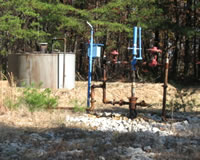
Gas Well Study is the examination of natural gas wells in West Virginia.
Underground Injection Control Class 2 Wells
These wells are used either for the disposal of oil and gas liquid waste or for the enhanced recovery of oil or natural gas.
Gas Well Study Site Visits
Annual reports, environmental assessments, and individual well information.
YouTube Videos
Select videos from the Gas Well Study YouTube channel.
What Happened at Fernow
An investigation into what caused the vegetation death in the land application area after landspraying hydraulic fracture flowback waste.
The Spill at Buckeye Creek
An investigation into a spill from a Marcellus well site into Buckeye Creek in Doddridge county.
The Details
Plunger Lift Technology on Gas Wells
Fluids Brought to the Surface during Production
Plugging a Well
How To Read a Lab Report
Information the Completion Report Provides
Casing and Cementing